
About Project
SentifyFlow is Automation of Scraping & Sentiment Analysis. SentifyFlow is an end-to-end data pipeline for performing the tasks below.
- Crawling Twitter (X) data
- Sentiment Analysis using fine-tuned BERT
- Sentiment Weighting & Scoring
- Data persistence to PostgreSQL
- Data lake storage in MinIO
- Alerting to Telegram & Email
- Fully orchestrated using Apache Airflow
- Fully containerized using Docker
This project is designed as a production-ready sentiment pipeline that is modular, scalable, and maintainable.
Tech Stack
Orchestration: Apache Airflow (Dockerized)
Containerization: Docker
Object Storage: MinIO
Database: PostgreSQL
Sentiment Model: Fine-Tuned BERT
Alerting: Telegram Bot + Email
Configuration: YAML
Language: Python
Architecture Overview
					┌──────────────────┐
					│  Apache Airflow  │
					│   (Dockerized)   │
					└─────────┬────────┘
							  │
		┌─────────────────────┴───────────────────┐
		│                                         │
   DAG Crawler                                DAG Analyzer
		│                                         │
		▼                                         ▼
  Docker: Crawler                         Docker: Analyzer
		│                                         │
		▼                                         ▼
	  MinIO  ─ ─ ─ ─ ─► PostgreSQL ◄─ ─ ─ ─ ─ ─ MinIO
		│                                         │
		└────────► Telegram & Email Alert ◄───────┘
Project Structure
SentifyFlow/
│   .env
│   .env.example
│   .gitignore
│   docker-compose.yaml
│   Dockerfile
│   README.md
│   requirements.txt
│
├───airflow
│   ├───config
│   │       airflow.cfg
│   │       catalog.yml
│   │       config.yml
│   │       credential.json.example
│   │
│   ├───dags
│   │   │   dag_analyzer.py
│   │   │   dag_crawler.py
│   │
│   ├───logs
│   │   │   airflow.log
│   │   │   sentifyflow.log
│   │
│   └───script
│       │   analyzer.py
│       │   crawler.py
│       │   helpers.py
│
├───analyzer
│   │   docker-compose.yaml
│   │   Dockerfile
│   │   requirements.txt
│   │
│   ├───config
│   │       catalog.yml
│   │
│   ├───model
│   │   └───sentiment-classifier-fine-tuned
│   │           config.json
│   │           pytorch_model.bin
│   │           special_tokens_map.json
│   │           tokenizer_config.json
│   │           vocab.txt
│   │
│   └───script
│           helpers.py
│           model.py
│           predict.py
│
└───crawler
	│   .env
	│   docker-compose.yaml
	│   Dockerfile
	│   requirements.txt
	│
	├───config
	│       catalog.yml
	│
	└───script
			crawling_data.py
			find_username.py
			get_token.py
			helpers.py
Pipeline Overview
SentifyFlow consists of two main DAGs:
dag_crawler: Retrieve Twitter data and save it
dag_crawler: Retrieve Twitter data and save it
dag_analyzer: Performing sentiment analysis & alerting
NB: The DAG Analyzer runs after the DAG Crawler finishes.
DAG Crawler
DAG Crawler is used to retrieve Twitter data, enhance the data (username) from results of crawling, and store it in a bucket storage & database. Below is the task flow of this DAG.
check_credentials
        ↓
crawling_tweets (Docker)
        ↓
find_username (Docker)
        ↓
insert_tweets
        ↓
export_raw_tweets
DAG Analyzer
DAG Analyzer is used to perform sentiment analysis using fine-tuned BERT, perform weighting, create a summary of the analysis results, and send alert via Telegram & Email. Below is the task flow of this DAG.
check_credentials
        ↓
sentiment_tweets (Docker)
        ↓
listing_file
        ↓
weighting_sentiment
        ↓
insert_sentiment
        ↓
send_alert
        ↓
housekeeping_file
Architecture of Storage
SentifyFlow uses two storage methods for the results of each process for each pipeline. SentifyFlow uses MinIO as object storage and PostgreSQL as a database.
MinIO (Object Storage)
The following is the structure of the bucket storage that is used.
sentifyflow-bucket/
│
├───auth
│
├───labeled
|
└───raw
NB:
auth: Stores JSON files containing credentials.
labeled: Stores CSV files containing labeled data.
raw: CSV files containing raw data.
PostgreSQL (Database)
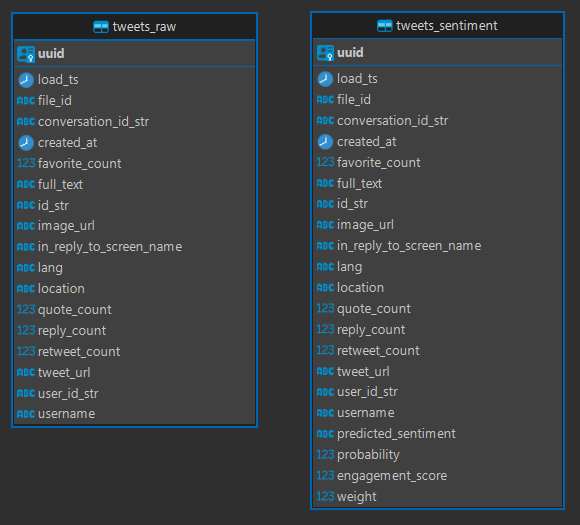
tweets_raw: Stores data containing raw data.
tweets_sentiment: Stores data containing labeled data.
Containerization
All components in this SentifyFlow project is running on Docker.
Airflow: Docker
Crawler: Docker
Analyzer: Docker
MinIO: Docker
PostgreSQL: Docker
DockerOperator is used to run crawling and sentiment analysis processes with the following objectives.
- Isolated environment
- Secure dependencies
- Scalable
Alert Output
Here is an example of the alert output of the analysis results that will be sent via Telegram and email.
📊 SentifyFlow Market Sentiment Alert (2026-02-20)
Period: 2026-02-13 — 2026-02-19

💡 Market Signal:
Index: 100.00/100 → 🟢 Bullish
Weighted Score: +1.0000
Net Score: +1.0000

📌 Sentiment Summary:
Positive: 59 (100.00%)
Neutral: 0 (0%)
Negative: 0 (0%)

⚖️ Pressure:
Bullish Pressure: 100.00%
Bearish Pressure: 0.00%

🎯 Model Confidence:
Avg Probability: 39.56%

🚀 Top Market Movers (highest weight):
1. @BudiBukanIntel | positive | weight: 6.3742
https://x.com/undefined/status/2024105000167723113
2. @TradingDiary2 | positive | weight: 5.6419
https://x.com/undefined/status/2023075414802137324
3. @TradingDiary2 | positive | weight: 2.3514
https://x.com/undefined/status/2024127800916021428

🔗 Link Task:
http://localhost:8080/dags/DEVdaganalyzer/grid?dagrunid=scheduled2026-02-20T07:02:00+00:00&taskid=sendalert
Key Features
- Fully automated
- End-to-end pipeline
- Fine-tuned BERT model
- Engagement-based sentiment weighting
- Dockerized & modular
- Production-style orchestration
- Alerting system
- Database consistency control
- Storage housekeeping
Future Improvements
- Dashboard Visualization (Streamlit / Superset)
- Real-time streaming (Kafka)
- Model retraining DAG
- MLflow integration
- Data quality validation (Great Expectations)
- API layer untuk expose sentiment index
Conclusion
SentifyFlow is an end-to-end data pipeline implementation that combines data ingestion from Twitter (X), sentiment analysis using fine-tuned BERT, and automatic alerting in an architecture orchestrated with Apache Airflow and containerized using Docker. With a clean split between DAG Crawler and DAG Analyzer, the system is designed to be modular, scalable, and production-ready. The integration of MinIO as object storage and PostgreSQL as a persistent database ensures data consistency and reliability at every stage of the pipeline. Overall, SentifyFlow represents a real-world application of Data Engineering and MLOps practices in building a structured, automated sentiment analytics system that is ready for further development to meet data-driven monitoring needs.
Project Impact:
Project Impact:
- End-to-End ML Pipeline: From data crawling, preprocessing, BERT inference, weighting, to alerting, everything runs automatically.
- Data Engineering Pipeline: Implementation of ingestion, storage, transformation, and persistence in a structured architecture.
- Production-Oriented Architecture: Orchestration using Airflow with containerized execution (DockerOperator) for environment isolation and scalability.
- MLOps Implementation: Integration of model inference in scheduled workflows with object storage, database persistence, and monitoring alerts.
- Alerting System: Automatically deliver sentiment summaries and weighting to Telegram and email as decision-support signals.
- Real-World Use Case: It can be used for market sentiment monitoring, brand tracking, and financial signal intelligence.
License
More About This Project
You can visit the repository of this project by click here.